How to Enter the Flow in Improvisation
So now, we've established the goal of this book and my research: to make us more and more available in the present moment, with all our creativity and resources ready to dance. To become what I call a virtuoso of the present moment - someone who can access whatever the moment is calling for.
But how do we actually get there? How do we enter that state where movement just flows through us effortlessly?
This is the question I want to explore with you: How do we enter the flow in improvisation?
What Is Flow for a Dancer?
You know that feeling when you're dancing and suddenly time disappears? When your body knows exactly what to do next without your mind having to figure it out? When movement just flows through you like you're being danced by something bigger than yourself?
That's what I mean by flow in dance. It's that state where there's no separation between me and the movement. Where I'm not forcing or controlling, but I'm also not passive. I'm in this perfect dance between effort and effortlessness.
In flow, my whole system becomes coordinated. My breath, my muscles, my awareness, my intuition - everything is working together. The movement that emerges feels both completely natural and completely surprising at the same time.
And here's what I've been discovering: flow isn't something that just happens to us randomly. There seems to be a mechanism to it, a process we can understand and work with.
How Does It Actually Work? The Retroactive Loop
Here's what I've figured out through my own dancing and research: flow follows a pattern, a kind of cycle that feeds back on itself.
Let me explain what I mean. In improvisation, each moment of authentic movement actually creates the information for the next moment. It's not linear like A leads to B leads to C. It's more like... I move, and that movement changes something inside me, which changes what I can perceive, which opens up new possibilities for movement.
So it's this continuous feedback loop where the output becomes the input. That's why I call it retroactive - because each moment of flow is actually creating the conditions for the next moment of flow.
What's Happening in Each Moment When We Dance
Okay, so let's break this down. What's actually happening in each split-second when we're moving?
Psychologist Mihaly Csikszentmihalyi (the creator of the concept of flow), drawing on research by J.E. Orme (1969), points out that based on calculations from biologist Jakob von Uexküll, the shortest time it takes our nervous system to discriminate between one set of information and another is about 1/18th of a second (roughly 50-60 milliseconds).
This means we're getting fresh snapshots of reality 10 to 18 times per second. Each brief window includes everything: the temperature of the air against our skin, the weight distribution in our feet, the rhythm of the music, the quality of light in the room, the presence of other people, internal sensations, emotional tones...
But from this massive stream of information, our conscious awareness only perceives a small part. Indeed, our state of awareness filters it.
The Spectrum of Awareness
We could say there's both a breadth and depth to awareness. The breadth is how many things we're aware of at once - like, am I just aware of my thoughts, or am I also aware of my breathing, my body sensations, the sounds around me, the energy in the room? The depth is how deeply we can access each thing we're aware of.
In normal daily life, most of us are probably living with a pretty narrow and shallow awareness. We're mostly in our heads, in our thoughts, maybe paying attention to what we can see. Our mental chatter tends to dominate everything else.
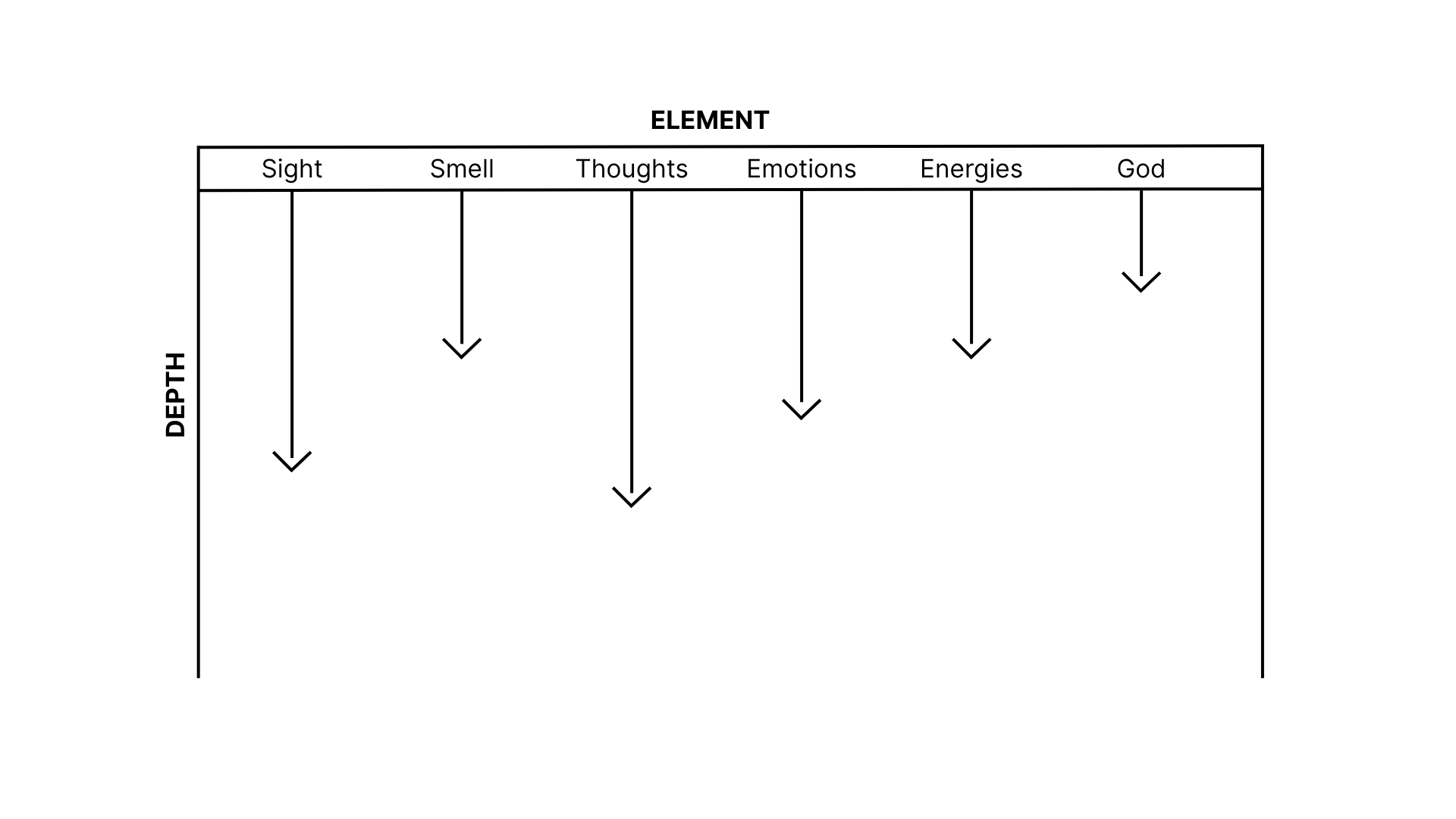
But in conscious dance, I'm working to expand both the breadth and depth of my awareness. I'm inviting my mental activity to step back from its usual dominance and making space for my body, my senses, my intuition to have more of a voice.
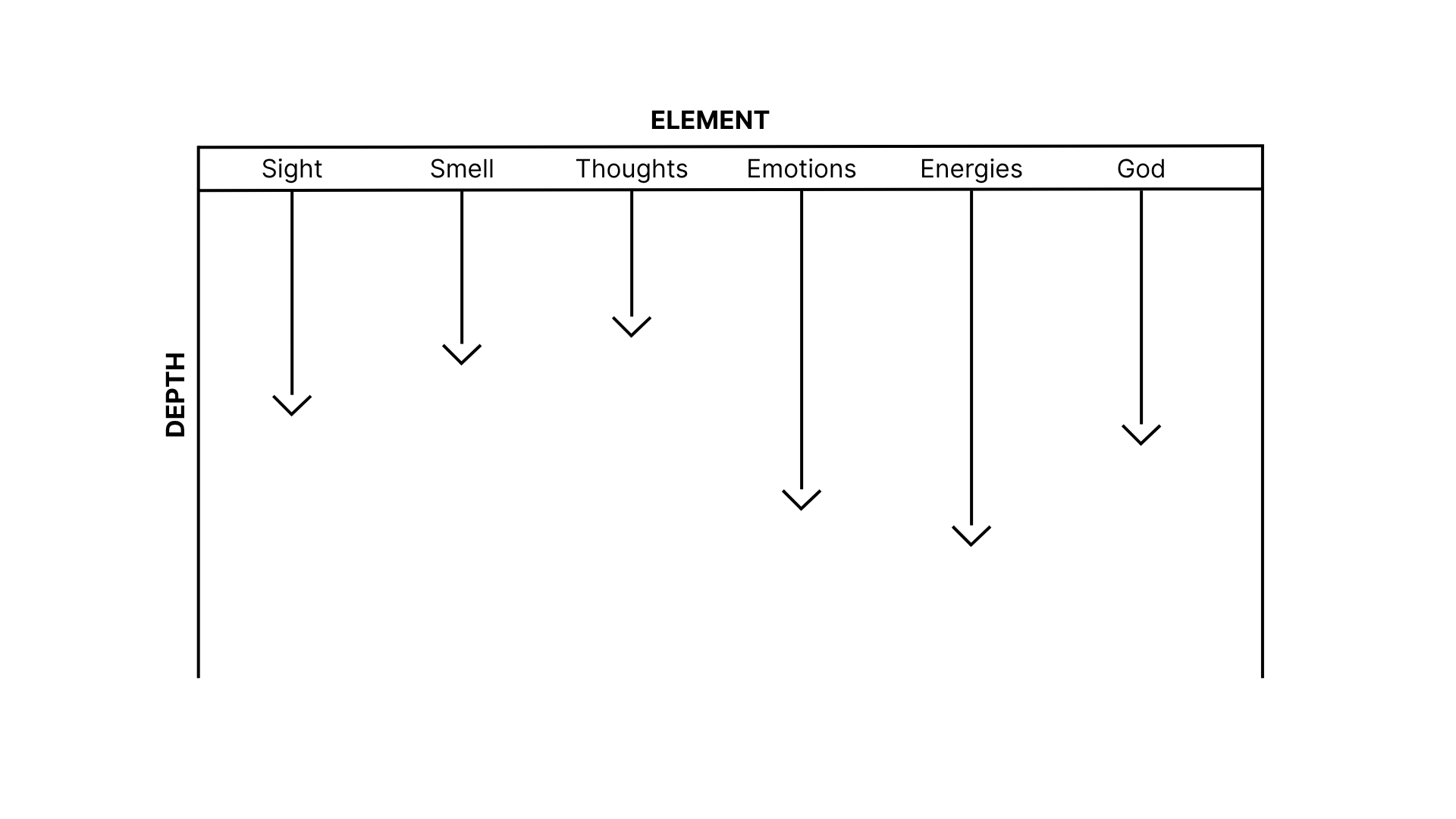
This connects to what authentic movement practitioners call "movement arising from genuine internal impulse rather than imposed external form."
When my awareness is contracted - when I'm anxious or self-conscious - I tend to perceive threat and limitation. The same environment that could be full of creative possibilities just looks scary or boring. But when my awareness is expanded - when I'm open and present - the same moment is full of doors, full of invitations to move and express.
There are different qualities of awareness I can access. Sometimes I'm in what I call a "protective state" - scanning for problems, trying to control outcomes, worried about how I look. Other times I'm in more of a "receptive state" - curious, open, willing to be surprised.
These different states change what information I can perceive. In the protective state, I might notice mainly the judgment of others, the risk of looking foolish, or the gap between my current ability and some imagined standard. But in the receptive state, the same room full of people becomes a field of creative possibility, and I can sense invitations to move that weren't visible before.
Doors and Pathways Become Available
So based on what I perceive - based on my state of awareness - certain pathways or "doors" become available to me.
These aren't abstract concepts. They're felt experiences. I might suddenly notice that my shoulder blade wants to initiate a spiraling movement. That's a door opening. Or I might have an image of moving like water, or feel an emotion wanting to express itself through gesture, or sense my whole body wanting to sway in a particular rhythm.
What I find fascinating is that doors appear and disappear moment by moment. A door that was available three seconds ago might have completely vanished, while new doors are constantly emerging.
Let me give you a sense of the different types of doors I've discovered in my own dancing:
The Door of Imagination
This door opens when images, stories, or fantasies inspire movement. Like suddenly feeling drawn to move as if I'm swimming through thick honey, or embodying a fierce animal, or moving like smoke. This door seems powerful because it can bypass my usual movement patterns and invite me into new physical possibilities. I might find myself in a fantasy where I'm a tree swaying in the wind, and this imagination gives me access to qualities of movement - the slow, rooted swaying, the responsive flexibility - that I couldn't find through direct instruction.
The Door of Emotion
This is perhaps the most familiar - allowing feelings to move through us physically. But this isn't about performing emotions or making emotional shapes. I'm talking about letting the energy of an emotion find its natural expression through the body, which often looks completely different from what I might expect. When I'm actually dancing anger, for instance, it rarely looks like stereotypical angry movement. More often, it has a quality of power and clarity, sometimes even stillness.
The Door of Somatic Movement
This door opens through pure physical sensation - the weight of my bones, the spiraling of my spine, the connection to gravity, the expansion of breath. This is movement that arises from listening to my body's own intelligence rather than imposing movement from the mind. Sometimes I'll notice that my tailbone wants to drop and spiral, and following that impulse leads me into a whole exploration of how my spine wants to move today.
The Door of Trance/Repetition
This involves repetitive, meditative movement that can shift awareness. This might be simple swaying, repetitive gestures, or rhythmic patterns that take me beyond ordinary awareness. I've found that when I discover a simple repetitive movement and stay with it long enough, the state of awareness shifts. The repetition gradually changes quality, becoming more effortless, more meditative. It's like I am devoting myself to something bigger through repetition.
The Door of Energetic Movement
This is dancing through the energetic body - moving energy rather than just moving muscles and bones. This can feel like being moved by something larger than myself, or like dancing the life force that animates the body. Sometimes I feel like my body becomes a channel for something much bigger than my personality, and I'm not moving myself but being moved. It's also entering an ecstatic state following rising energies through the body.
What I'm learning is that improvisation is partly about sensing these doors as they emerge, and partly about developing the courage to enter them fully. I can sense the doors but I still hesitate at the threshold sometimes. I feel the impulse to move in a particular way but then second-guess myself or water down the movement to something safer.
What I'm particularly interested in is whether I can learn to move fluidly between these doors within a single improvisation, or even within a single moment. I might start with somatic awareness of my spine, which triggers an emotional response, which sparks an image, which leads to ecstatic movement, which settles into trance-like repetition.
The doors aren't isolated but part of a continuum. As I develop sensitivity, I can begin to sense when one door is closing and another is opening. I'm learning to follow the natural flow between different types of movement impulses rather than getting stuck in any single approach.
Sometimes I think of it like having multiple radio stations available, and I can tune into whichever frequency is coming in most clearly in any given moment. Other times it's more like having different languages I can speak - sometimes the situation calls for the language of emotion, sometimes for the language of imagination, sometimes for the language of pure physical sensation.
We Enter a Door and Physicalize It
So I sense an impulse coming through one of these doors. Now what?
I enter the door and physicalize it in my body. But everything starts with a spark - this tiny little ignition that I need to feel very, very carefully. It's always very much nothing at first.
Like, I might get the faintest sense that my shoulder wants to roll, or that there's some energy moving through my ribs, or that my weight wants to shift slightly. It's so subtle that my mind could easily dismiss it as "not real" or "not enough."
The more attention and energy I give to that tiny spark, the more I dance into it, the more obvious it becomes. There are infinite ways to physicalize any given impulse. Let's say I feel drawn to move like water. I could express this as gentle, flowing arm movements. Or I could let my whole spine undulate like a wave. Or I could imagine my bones melting and reforming. Or I could move as if I'm pushing through thick liquid. Each choice creates a completely different quality of movement, a different texture, a different conversation between my inner experience and the physical world.
This is where I'm developing what I think of as my movement vocabulary - not choreographed steps, but qualities, textures, forms that can express the richness of my internal landscape. Some movements are sharp and percussive, others smooth and continuous. Some are expansive and reaching, others contractive and inward. Some are grounded and heavy, others light and floating.
In chapter 5, we're going to explore how to develop this movement vocabulary. How to create rich physicality that can hold and express the full spectrum of what we experience inside. How to move with different textures - sometimes rough and jagged, sometimes silk-smooth. How to play with different forms - spirals, lines, curves, angles. How to work with different qualities of energy - explosive, sustained, vibratory, flowing.
What I'm after isn't becoming a technically perfect dancer, but becoming someone who can embody their authentic experience with such richness and precision that the inner world becomes visible in the outer world. When someone is watching me move, I want them to be able to feel something of what I'm experiencing inside - not because I'm performing it, but because I'm living it so fully that it radiates through my physicality.
We Enter Flow
My body starts to enter a state where it just flows. Where I'm not controlling and deciding every movement I am doing, but I'm being moved. Like something larger than my controlling mind is moving me.
It reminds me of wing foiling. To get the board up out of the water, it takes this very subtle listening and tuning in to the wind and the waves. I have to feel for these tiny shifts in pressure and respond to them precisely. But once I manage to lift off, there's no friction to continue! I'm flying, and it feels effortless.
The same thing happens in dance. Once I lift off into real flow, it becomes self-sustaining.
What I find most interesting about flow is how it changes the quality of movement itself. When I'm trying to move, when I'm choreographing from my mind, the movement has a certain quality - it's controlled, predictable, sometimes forced. But when I'm in flow, the movement has this alive quality, like it's generating itself. It's full of micro-adjustments and responses that I couldn't plan if I tried.
Flow Changes Our State of Awareness
And here's where the cycle completes itself: entering flow changes my state of awareness. Moving authentically literally reorganizes my awareness. My breathing changes, my perception expands, and suddenly I can sense possibilities that weren't available before. Each time I enter authentic flow, I feel like I'm rewiring my nervous system, expanding my capacity for presence, deepening my trust in my own body wisdom.
I notice this in my daily life too. When I've had a rich flow experience in dance, I carry something of that state with me afterward. I'm more available to spontaneous conversation, more able to respond creatively to unexpected situations, more willing to trust my instincts in decision-making.
It's like flow gives me a taste of what's possible when I'm not trying to control everything from my thinking mind. When I let my whole system - body, heart, intuition, intelligence - work together as one integrated whole.
So the flow feeds back into the beginning of the cycle. New awareness, new stimuli perceived, new doors available. And what's interesting is, each time through the cycle, I develop a little more capacity. I become a little more sensitive to subtle impulses, a little more willing to trust what I'm sensing, a little more skilled at physicalizing what wants to emerge. At least that's what I've experienced.
The Go Through System - Nothing More Complex
After all this exploration, what I've come up with is this simple system for understanding how flow works:
State of Awareness → Stimuli → Pathways/Doors → Movement/Physicality → Flow → New State of Awareness
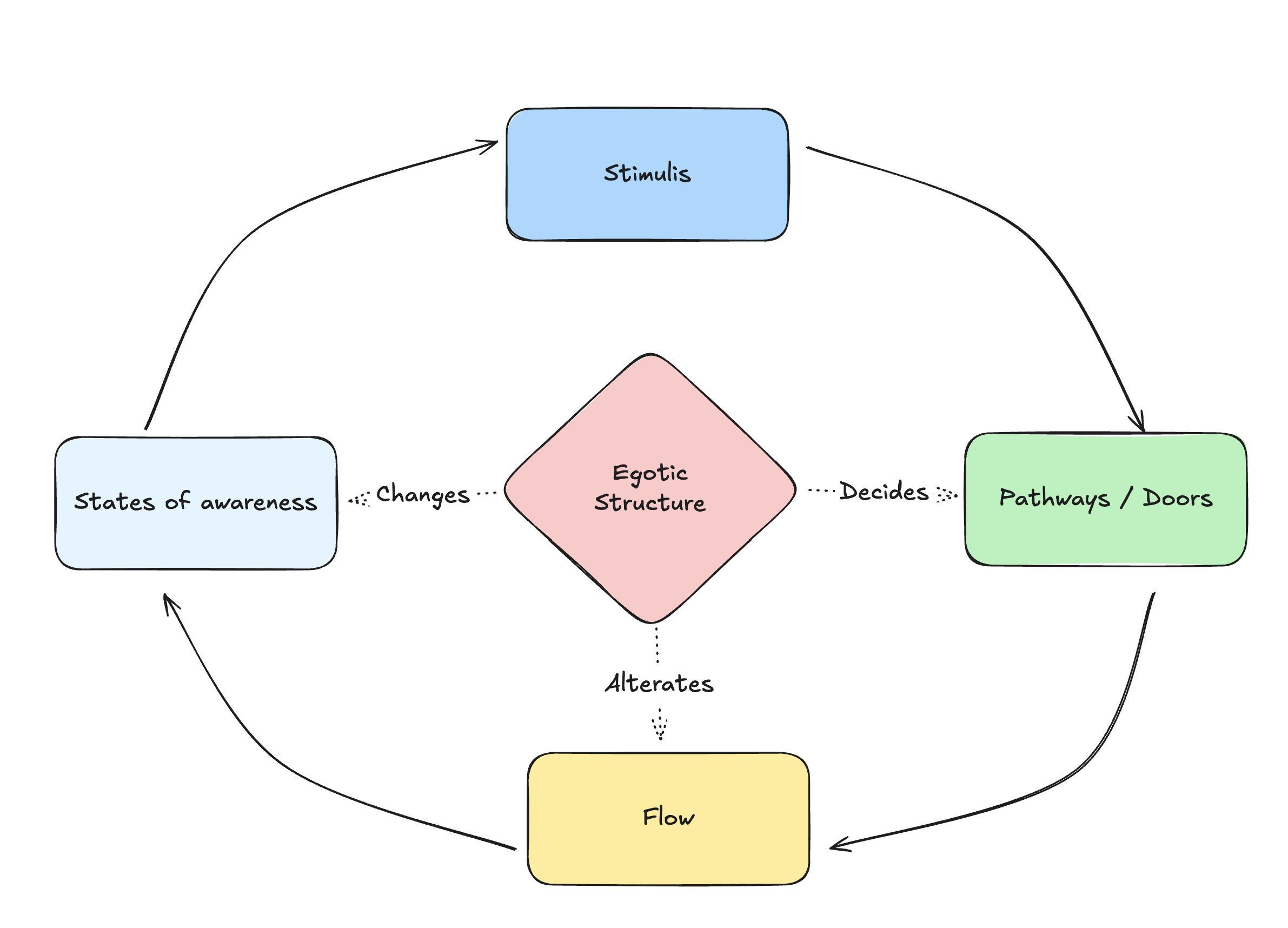
And then it cycles back around. That's it. Nothing more complex than that.
My state of awareness determines what I can perceive from all the information that's constantly available. Based on what I perceive, certain doors become available to me. When I sense an impulse coming through one of these doors, I can choose to physicalize it in my body. If I do this with real commitment - if I really go for it - I can enter flow. And flow changes my state of awareness, which changes what I can perceive, which opens new doors...
An Example - Following the Path from Door to Door
Let me give you a concrete example of how this whole cycle works from my own dancing.
I was dancing the other day and a piece of music came on that immediately brought me into an imaginative space. My awareness was open at that moment, so this particular door was available to me.
I found myself in this fantasy where I was a kung fu master on a battlefield. I was moving in slow motion, feeling this energy moving around me, working with invisible forces.
I surrendered completely to this imaginative trip and what it had to offer me. As I moved deeper into this fantasy, I started moving faster, going in and out of slow motion. And what I noticed was that all this movement through the imaginative realm was actually changing my state of awareness.
I started feeling a lot of energy throughout my body - like the fantasy was waking up my actual energy body. The kung fu trip had brought me into deep awareness of energy flowing through me, so now a different door was opening.
I naturally transitioned into ecstatic movement - letting these energies move my body rather than me moving my body. I was being danced by these forces I could feel moving through me.
Then I entered another flow as the music changed. I felt this strong energy rising through my spine, so I went into a more somatic exploration, letting my spine lead while my limbs stayed relaxed. This brought me to notice some tension in my throat area, around what you might call the expressive chakra. My spine felt blocked at that moment, so I started exploring that emotionally, letting whatever wanted to be expressed through that area of my body have its voice. I then had a self-therapy session through movement through a process I'll explain in later chapters to work with an internal voice that was blocking my self expression, making me feel illegitimate.
And this is conscious dance - jumping from door to door, following the flow from one state to another, never forcing it but always staying available to whatever wants to emerge next.
Each transition happened because the previous movement had changed my state of awareness, which revealed new information, which opened new doors. The cycle kept feeding itself.
What's Coming Next
So now you have a sense of the basic mechanism of how flow works in improvisation - at least from my understanding of it. But knowing the theory is just the beginning. In the next chapters, I'm going to share what I've learned about the different parts of this model so you can explore it in your own dancing:
- How to gain deeper awareness - developing the sensitivity to perceive what's actually available in each moment
- The presentation of the doors and the modes of dancing - understanding the different pathways through which movement can emerge
- The physicality and how to improve it - developing the ability to embody impulses fully and with commitment
- And then what I think is the most important part: how to work with the blockages - because what usually stops me from accessing flow isn't a lack of technique, but the internal voices and patterns that keep me stuck
The question I'm left with is: how do I become a virtuoso of this process? How do I develop the sensitivity to feel those tiny sparks, the courage to follow them, and the skill to sustain the flow once it begins?