Awareness - The Foundation of Conscious Dance
In this chapter, I'll focus on the first step of our retroactive loop introduced in the previous chapter: the state of awareness. But before we explore how to develop greater body awareness in dance and access a bigger intelligence that wants to move through us, I need to share my understanding of consciousness itself. This foundation will make everything else in this book clearer.
I want to tell you about where this perspective comes from. Through various trance states, meditation sessions, extended dance sessions or psychedelic and shamanic experiences I've had experiences that took me beyond my ordinary sense of self. In some deeper states, I lose the sense of being "Eliott." I can't think in words, yet awareness remains—clear and accessing realms normally hidden from ordinary awareness. I've experienced what felt like downloading movement patterns from somewhere beyond my personal knowledge and being "egoless", a simple observer of a bigger intelligence. So it's from this space of direct experience that I'll share my personal understanding of "consciousness" and "awareness".
Precision: you don't have to believe any of this to benefit from this approach. I share it to clarify the foundation of this book. Whether you see these as real experiences or interesting brain states, the practical benefits for dance remain the same.
A Post-Materialist View of Consciousness
My understanding comes from a post-materialist perspective, which differs from the mainstream materialist view most of us grew up with.
The Materialist View
The materialist worldview says consciousness is produced by the brain. Your thoughts, awareness, and sense of self are byproducts of neural activity. When the brain dies, consciousness ceases to exist. This view dominates Western science and medicine, suggesting that matter is primary and consciousness emerges from complex arrangements of matter.
This perspective shapes how we approach mental health (through brain chemistry), education (through information processing), and even spirituality (often dismissed as wishful thinking or neurological phenomena). It's the foundation of our technological civilization.
The materialist approach treats consciousness as an epiphenomenon—a secondary effect that emerges when neural networks reach sufficient complexity. From this view, subjective experience is essentially an illusion created by information processing in the brain. Free will becomes questionable, since all decisions would ultimately be determined by prior physical causes. Spiritual experiences are explained as hallucinations, misfiring neurons, or evolutionary artifacts that once served survival purposes.
This worldview has led to remarkable technological progress and medical breakthroughs. It's given us brain scans that can predict some decisions before we're consciously aware of making them, medications that can alter mood and perception, and detailed maps of which brain regions activate during different mental activities.
The Post-Materialist View
The post-materialist view suggests consciousness isn't produced by the brain, but is fundamental to reality itself. The brain acts more like a radio receiver that filters infinite consciousness into a manageable stream for daily life. This means consciousness is primary, and matter emerges from it rather than the other way around.
Post-materialist researchers like Dr. Pim van Lommel (studying near-death experiences), Dr. Dean Radin (researching psychic phenomena), and Dr. Rupert Sheldrake (exploring morphic resonance) have documented phenomena that are difficult to explain through materialist frameworks. Their research suggests consciousness can operate independently of brain activity and access information through non-local means.
Ancient Wisdom Traditions
This perspective has deep roots across cultures that have been exploring consciousness for thousands of years:
Advaita Vedanta recognizes that "Atman is Brahman"—individual consciousness is identical to universal consciousness. The Upanishads state "Tat tvam asi" (That thou art), pointing to the fundamental identity between individual awareness and cosmic consciousness. This tradition uses practices like self-inquiry ("Who am I?") to dissolve the illusion of separation between observer and observed.
Buddhism points to the illusory nature of the separate self and the interconnectedness of all phenomena. The doctrine of anatta (no-self) suggests that what we take to be a solid, separate self is actually a flowing process of interdependent phenomena. Buddhist meditation practices like vipassana are designed to see through the illusion of separation and recognize the empty, interdependent nature of all experience. I did a Vipassana retreat and after 10 days of looking in the right direction, the illusion of separation falls.
Zen speaks of "original mind" that exists before thoughts arise. The famous Zen question "What is your original face before your parents were born?" points to the awareness that exists prior to all conceptual knowledge and personal history. Zen meditation (zazen) involves sitting in this original awareness without trying to achieve any particular state.
Sufism uses the metaphor of the drop dissolving back into the ocean—what seemed separate was never truly apart from the whole. Sufi practices like whirling and dhikr (remembrance) are designed to dissolve the ego-self back into Unity. The Sufi poet Rumi wrote: "You are not just the drop in the ocean, you are the entire ocean in each drop."
Indigenous traditions worldwide recognize consciousness as the animating force in all of nature. Shamanic practices involve journeying into non-ordinary states of consciousness to access spiritual guidance, healing, and wisdom. These traditions understand that consciousness extends far beyond human beings to include animals, plants, stones, and the land itself.
Yoga holds that the ultimate goal is the recognition that individual consciousness (jivatman) is one with universal consciousness (paramatman). The practices—asanas, pranayama, meditation—are designed to remove the veils that obscure this recognition. Patanjali's Yoga Sutras describe samadhi as the state where the meditator, the act of meditation, and the object of meditation merge into one.
Modern consciousness research is beginning to validate aspects of these ancient insights, suggesting that awareness might play a more fundamental role in reality than previously imagined.
Who Are You Really? Beyond the Voice in Your Head
Before we explore maps of consciousness, let's start with a simple recognition about who you actually are. Most of us spend our lives completely identified with what I call the "egotic structure"—that voice in your head that's constantly thinking, planning, worrying, judging, and commenting on everything.
A simple experiment: Right now, can you observe your thoughts? Can you notice that there are thoughts happening? If you can observe your thoughts, then you can't BE your thoughts—because the observer is always different from what's being observed.
This recognition comes from the ancient practice of "neti neti" (not this, not this):
- You can observe your body sensations, but you are not them because you can observe them
- You can observe sounds around you, but you are not them because you can observe them
- You can observe your thoughts, but you are not them because you can observe them
- You can observe your judging mind, but you are not it because you can observe it
So what are you? You are the witnessing awareness that can observe all of these experiences without being limited by any of them.
This witnessing awareness is what remains constant whether you're happy or sad, thinking or not thinking, dancing or sitting still. It's the space in which all experience happens, but it's never changed by any particular experience.
Small Self and Big Self
From this recognition, we can distinguish between two aspects of our identity:
Small Self (Ego) - This is your personal story—thoughts, emotions, memories, all the "me" concerns that make up your individual identity. It includes your fears, desires, preferences, and the ongoing mental commentary about your life. The small self isn't wrong—it's necessary for functioning in the world. But it's limited.
Big Self (Pure Consciousness) - This is your true nature as the witnessing awareness—the consciousness that can observe the small self without being trapped by it. This is what remains when all the personal content falls away. It's not personal to you—it's the same witnessing awareness that exists in every conscious being.
The Ocean and the Whirlpool
To understand how individual consciousness relates to universal consciousness, imagine consciousness as an infinite ocean—vast, timeless, containing all possibilities. This is Universal Consciousness.
Within this infinite ocean, whirlpools form. Each whirlpool appears separate from the ocean, with its own distinct motion and character. But the whirlpool is never actually separate—it's just ocean water spinning in a particular pattern.
Individual consciousness is like one of these whirlpools. We appear to be separate beings, but we're actually localized expressions of the one Universal Consciousness. The deeper we go into the tip of the whirlpool, the more trapped we become in self-referential loops—what Olivier Chambon calls "autoréflexions"—thinking about thinking, worrying about worrying, caught in the endless mental mirrors of the small self.
The walls of the whirlpool act like mirrors facing each other, creating infinite reflections. These are the ego's mental patterns: "What will people think? Am I good enough? What if I fail?" These thoughts bounce back and forth, creating a hypnotic trance that makes us forget our true nature as the ocean itself.
But we can expand our way back out of the whirlpool. As we move up from the narrow tip toward the wider opening, we access broader bandwidths of Universal Consciousness until we recognize our true nature as the ocean itself.
The different levels of the whirlpool represent different states of consciousness—from the most contracted (caught in ego patterns) to the most expanded (recognizing ourselves as infinite consciousness). Dance can be a way to shift our position in this whirlpool, moving from contraction toward expansion.
This metaphor helps me understand why spiritual practices often involve some form of dissolution or letting go. I'm not trying to become something I'm not—I'm trying to remember what I've always been. The whirlpool doesn't need to struggle to become the ocean; it just needs to recognize that it was never separate from the ocean in the first place.
When I'm spinning tightly in the narrow tip of the whirlpool, my perception is severely limited. I can only see my immediate concerns, my personal problems, my individual story. But as I expand toward the opening, my perspective widens dramatically. I begin to see patterns, connections, and possibilities that were invisible from the contracted state.
The process of expansion isn't about getting rid of the whirlpool—my individual perspective remains valuable and necessary. It's about recognizing that the whirlpool is a temporary formation within something much vaster. This recognition brings both humility (I'm not as separate and important as I thought) and empowerment (I have access to infinite creative potential).
The Six Levels of Expansion
Based on research by Dr. Olivier Chambon and others into altered states of consciousness, there's a consistent pattern to how individual consciousness can expand toward Universal Consciousness:
Level 1: Ordinary Ego Consciousness - This is where most of us spend most of our time—trapped in personal thoughts, concerns, and the mental chatter of the small self. At this level, we're completely identified with our personal story, our problems, our desires and fears. We're caught at the very tip of the whirlpool, spinning in increasingly tight loops of self-referential thinking.
Level 2: Personal Unconscious - Here we begin to access hidden memories, suppressed emotions, and traumatic material that's been stored outside of ordinary awareness. This is still personal material, but it's the beginning of expanding beyond the surface layer of ego consciousness.
Level 3: Non-Local Consciousness - At this level, awareness begins to transcend the normal limitations of time and space. People report experiences of telepathy, clairvoyance, or accessing information they couldn't possibly have known through ordinary means. It's as if consciousness is revealing its true non-local nature.
Level 4: Transpersonal Consciousness - Here we access what seems to be collective fields of awareness—archetypal realms, ancestral wisdom, species memory, even contact with what feel like other intelligences or spirit beings. This is the realm that shamans have been navigating for thousands of years.
Level 5: Spiritual Encounter - At this level, consciousness makes direct contact with what can only be described as Divine intelligence. There's still some sense of a "self" encountering "the Divine," but the boundaries are becoming very fluid.
Level 6: Mystical Fusion - This is complete dissolution into Pure Consciousness itself. There's no longer any sense of being a separate self encountering something else—there's just the one Universal Consciousness, recognizing itself. This is what the mystics mean when they say "Atman becomes Brahman"—individual consciousness realizes it never was separate from Universal Consciousness.
Attention and Awareness
To work skillfully with different states of consciousness, we need to understand the distinction between attention and awareness.
The Sky That Holds Everything
Awareness is like the sky—vast, open, and capable of holding any kind of weather. Clouds, storms, and sunshine all come and go, but the sky remains unchanged. Similarly, awareness remains present whether you're caught in ego consciousness or expanded into mystical states.
When I am angry, my attention is fixated on that anger. However, when I am aware, I recognize that I am observing the anger. I am not the anger itself but rather the witness to it.
This distinction is crucial because awareness provides the context within which attention operates. While attention narrows in on a particular aspect of my experience, awareness holds the larger field, enabling me to see the bigger picture.
Exercise: Right now, what are you aware of? Perhaps these words, sounds around you, the feeling of your body, any emotions present. Now—what is aware of those things? That which is aware is awareness itself—the unchanging space that contains all experience.
Attention: The Focused Beam
Attention is like a flashlight beam that illuminates specific areas within the vast space of awareness. Attention is trainable, moveable, and powerful—where you place your attention shapes your experience and determines what possibilities become available.
You can experiment with this right now. Shift your attention from these words to your breathing... now to sounds in the room... now to the feeling in your feet. Each shift changes your experience and reveals different information.
This understanding appears in many traditions. In Buddhist meditation, there's the distinction between the object of meditation (what attention focuses on) and mindfulness (the aware presence that observes). Advaita Vedanta speaks of the difference between vrittis (mental modifications that attention follows) and the witness consciousness (sakshi) that observes them. Yoga distinguishes between dharana (concentration of attention) and dhyana (pure awareness).
Awareness: The Unchanging Space
Awareness is the witnessing capacity within consciousness that can recognize what's happening at any level. It's what allows me to notice: "I'm caught in mental loops right now" or "Something is shifting—I'm accessing a different state of consciousness."
This witnessing capacity is what remains constant through all experiences. Whether I'm in ordinary ego consciousness or expanded mystical states, awareness is what recognizes and observes whatever is happening.
The Spectrum of Awareness
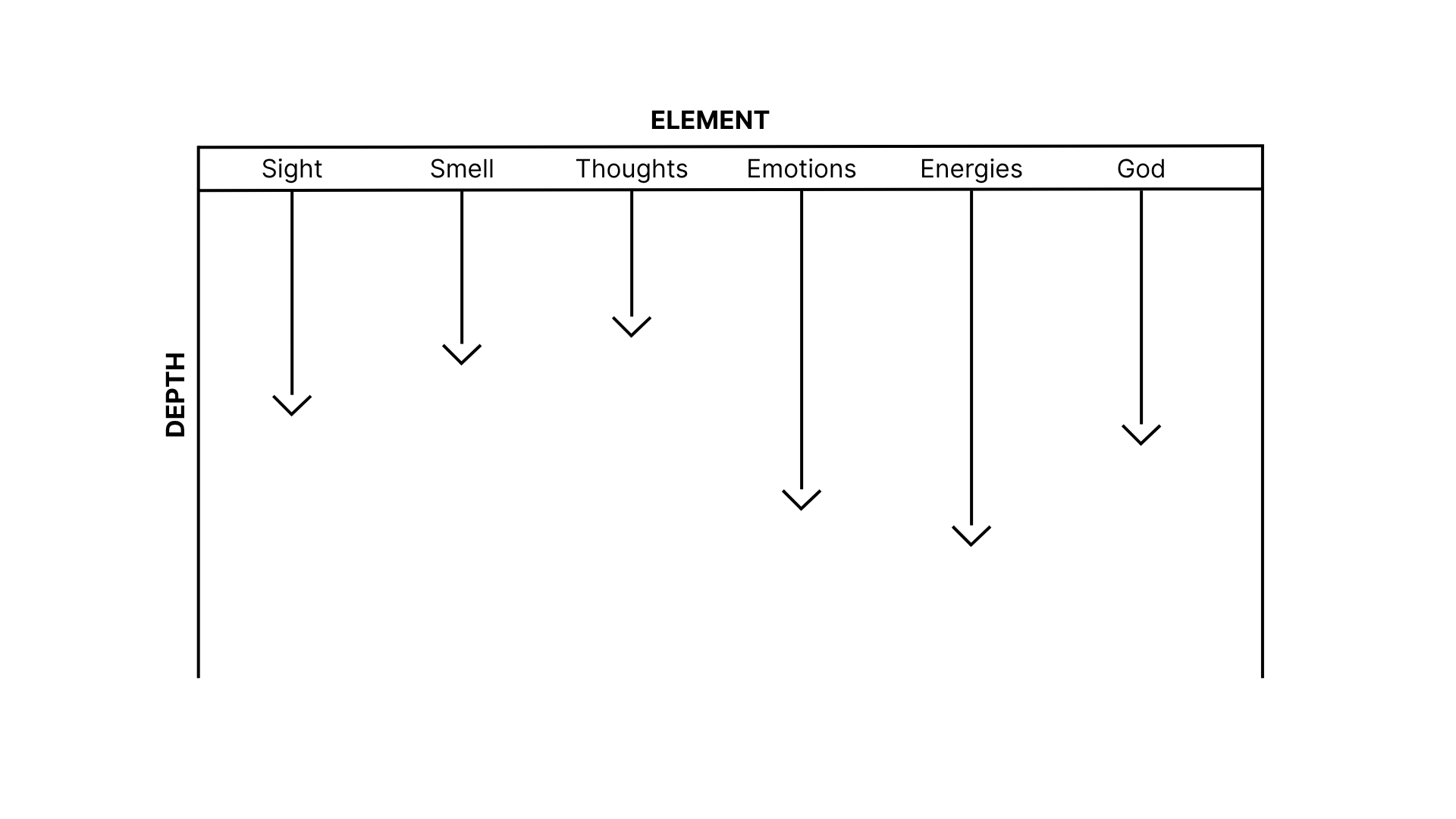
Awareness itself has different qualities and dimensions. Think of it as having both breadth and depth, and operating through different channels:
Breadth is how many things you're aware of simultaneously. Depth is how deeply you can access each thing you're aware of.
Different Types of Awareness
- Visual awareness: What you see, both focused and peripheral vision
- Auditory awareness: Sounds, music, silence, the quality of acoustic space
- Somatic awareness: Body sensations, temperature, pressure, movement, posture
- Interoceptive awareness: Internal body signals like heartbeat, breathing, hunger
- Emotional awareness: Moods, feelings, emotional currents
- Mental awareness: Thoughts, concepts, inner dialogue, planning
- Social awareness: Presence of others, group dynamics, relational fields
- Energetic awareness: Subtle sensations, life force, vitality
- Spatial awareness: Your position in space, the geometry of your environment
Different States of Consciousness involve different awareness profiles:
- Ordinary waking consciousness: Mostly visual and mental awareness, with some auditory. Limited body and energetic awareness.
- Dream states: Primarily visual and emotional awareness, with different logic and time perception. Mental awareness operates differently.
- Driving consciousness: Peripheral visual awareness becomes prominent, with attention partially elsewhere. Often accompanied by a trance-like state.
- Flow states: Somatic and energetic awareness become prominent. Mental chatter decreases. Time perception changes.
- Meditative states: Awareness of awareness itself becomes primary. The witness consciousness comes into focus.
- Expanded states: Awareness can include archetypal realms, collective memories, non-local information, transpersonal fields.
In ordinary daily life, most of us live with narrow and shallow awareness—mostly mental chatter with limited body awareness. But through conscious practices like dance, we can expand both breadth and depth, accessing much richer possibilities for experience and expression.
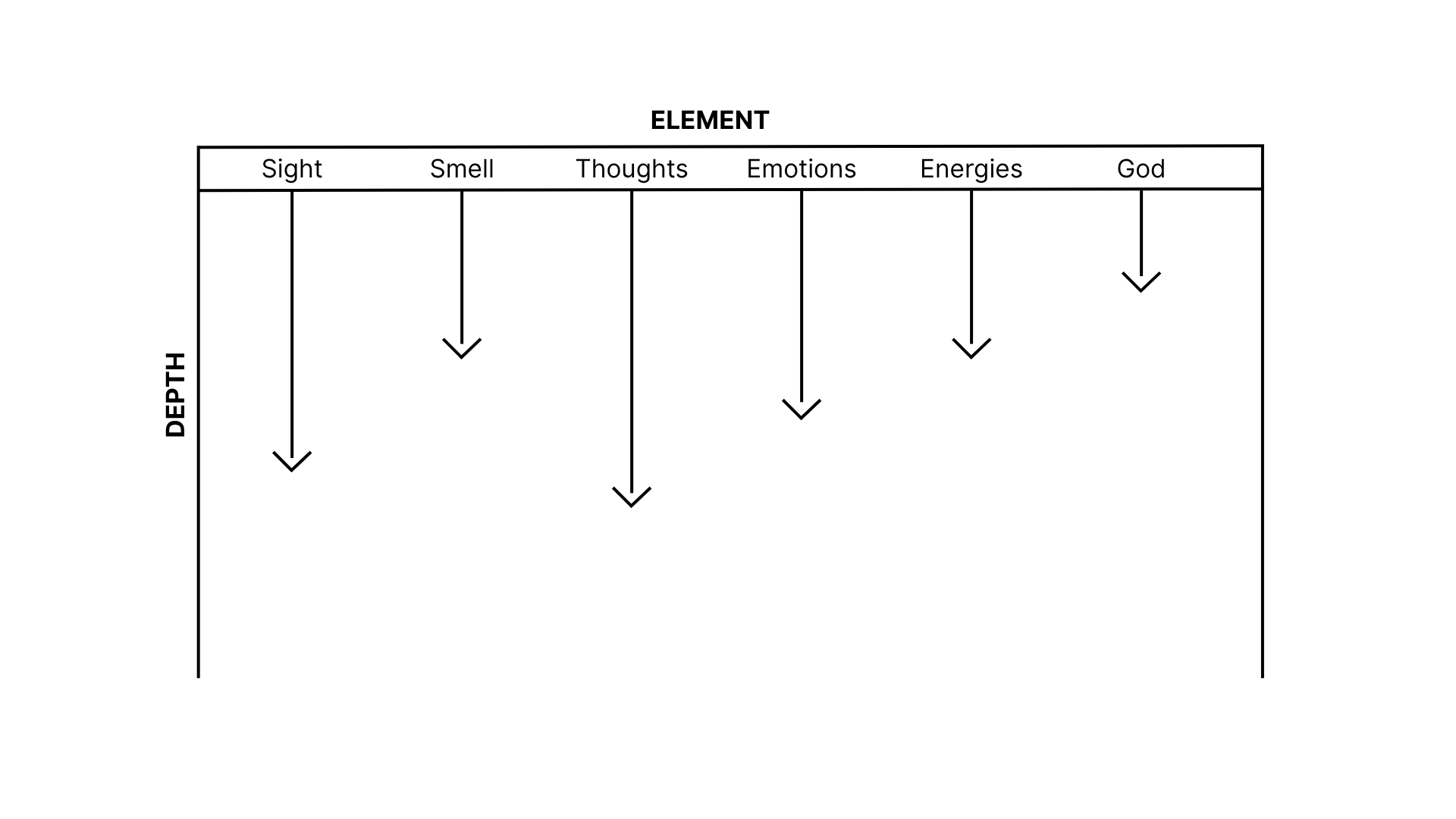
You might be aware of your breathing in a shallow way—just noticing it's happening. Or deeply—feeling the texture of each inhale, the pause between breaths, how breath moves through different parts of your body, the emotional quality of your breathing pattern.
Bringing Consciousness and Awareness Together
Now to connect our understanding of consciousness with awareness, many spiritual traditions speak of "three worlds" or different realms of reality:
Ordinary World corresponds to Levels 1-2 on our six-level map—ego consciousness and personal unconscious material. This is the realm of daily life, personal concerns, and individual psychology.
World of Dreams corresponds to Levels 3-4—non-local and transpersonal consciousness. This is the realm of archetypes, spirit beings, collective fields of information, and experiences that transcend ordinary time and space.
World of Essences corresponds to Levels 5-6—spiritual and mystical consciousness. This is the realm of direct contact with Divine intelligence and ultimate unity.
The key insight: these aren't separate worlds you travel to—they're different bandwidths of the one consciousness that you are. When awareness accesses a different part of consciousness, you change your state of awareness and suddenly have access to completely different types of information and creative possibility.
Myths to Demystify
Before we go further, let's clear up some common misconceptions about consciousness and presence:
The "Be Present" Myth
You've probably heard teachers say "be in the present moment." But you're always in the present moment. You can't actually be anywhere else. When you think about the past or future, those thoughts are happening now, in the present.
What actually changes isn't your position in time, but the quality of your awareness. When we say someone is "not present," we mean their awareness is narrow and shallow, fixated on mental content rather than open to the full richness of this moment.
The Quality of Awareness
It's not about forcing yourself into the present—you're already here. It's about expanding the breadth and depth of your awareness so you can perceive more of what's actually available in this moment. A rich present-moment awareness includes thoughts about the past and future when they're relevant, but isn't trapped by them.
The Mind as Tool, Not Enemy
Another myth is that we need to "stop thinking" or "quiet the mind" to be spiritual or present. This misunderstands the mind's role. The mind is a useful tool for understanding the world, solving problems, and navigating life. The issue isn't that we think—it's that we often become completely identified with our thoughts.
The goal isn't to silence the mind but to rebalance our relationship with it. Instead of being unconsciously driven by mental patterns, we learn to use thinking consciously while maintaining our identity as the awareness that can observe thoughts without being limited by them.
Presence Includes Everything
True presence doesn't mean being in some special peaceful state. It means having enough awareness to include whatever is actually happening—including anxiety, excitement, boredom, or any other experience. Fighting against what's present actually takes us out of presence. Accepting and including what's here brings us deeper into the aliveness of this moment.
Why This Matters for Dance
Understanding consciousness isn't just philosophical—it has practical implications for how we dance and what becomes possible through movement.
The Dance-Consciousness Progression
In the first few minutes of dancing, I'm typically working with shifting attention from mind to body, from contracted to more open states. But if I continue dancing without stopping, if I really commit to following the movement that wants to emerge, something happens: my awareness expands further and further, accessing broader bandwidths of consciousness.
Extended dance sessions can take me into what the Sufis describe as "returning to the divine ocean"—dissolving into the "big sea" of Consciousness. The longer I dance, the more I move beyond my personal limitations and access what I can only describe as a bigger intelligence that begins to guide my movement.
This is when dance becomes truly interesting. Instead of me moving my body, I start to feel like I'm being moved by something far more intelligent than my personal mind. My body begins moving in ways that surprise me, with a grace and intelligence that I couldn't choreograph if I tried.
What Becomes Available
When I access expanded states of consciousness in dance, I've noticed three distinct kinds of intelligence become available.
Néguentropie - The Creative Organizing Force
Néguentropie refers to the tendency of consciousness to naturally organize chaos into coherent patterns. It's the opposite of entropy—instead of things falling apart, they come together in increasingly sophisticated ways.
In dance, this shows up when I'm in a state where everything just... clicks. My movement becomes effortlessly coherent. Without trying to choreograph anything, sequences naturally flow into each other. Gestures connect to create phrases that feel complete. There's an invisible organizing principle at work that I can feel but can't quite explain.
Here's the difference I notice: In ordinary consciousness, if I improvise, my movement often feels fragmented. I'll do a gesture, then another, but they don't really connect. There's no throughline. But when I access more expanded states, even if I'm moving randomly, patterns emerge. Themes develop and resolve. The dance starts to have a structure that I didn't consciously plan.
It's like the difference between throwing paint randomly at a canvas versus watching the paint somehow organize itself into a coherent image. The néguentropic force is what creates that spontaneous coherence.
I notice this particularly when I'm deep in flow. My body finds connections between movements that my mind never would have thought to put together. A gesture in my left hand somehow finds its echo in my right hip three measures later. A quality of energy I explored early in the dance returns transformed at the end. Nothing is planned, but everything feels intentional.
Scientists studying complex systems talk about "self-organization"—how certain systems naturally evolve toward greater complexity and order. I think that's what's happening with consciousness in dance. When I get out of my head and access larger awareness, movement naturally self-organizes into increasingly sophisticated patterns.
The practical skill I'm developing is learning to trust this organizing force instead of trying to control everything with my mind. When I feel néguentropie at work, I follow where it's leading rather than imposing my own agenda.
Entéléchie - The Self-Healing Intelligence
Entéléchie is different. This is the intelligence that knows exactly what I need in order to heal, grow, and become more fully myself. The word comes from Aristotle—it means "having in itself its end and perfection."
Here's what I mean: Sometimes when I dance, my body moves in ways that release specific tensions I didn't even know I was holding. Or particular emotions surface and express themselves with their own natural rhythm. Or I find myself accessing memories or insights that my conscious mind couldn't reach on its own.
This isn't néguentropie organizing random material into patterns. This is a deeper intelligence that has an agenda—it knows what needs to happen for my development and healing.
The difference became clear to me after a specific session in 2023. I went into the studio feeling stuck around some relationship patterns I couldn't figure out. I didn't plan to work on this—I just started moving. Within twenty minutes, my body spontaneously moved into a position that triggered a childhood memory I had completely forgotten. The emotion that came up was intense, but as I kept moving, allowing it to express, there was this sense of something ancient being released. The entéléchic intelligence knew exactly what needed to surface, in exactly the right sequence.
This is what people in trauma healing call "the wisdom of the body." Peter Levine talks about how the body knows how to complete defensive responses that got frozen during trauma. Bessel van der Kolk describes how the body keeps the score and also contains its own healing intelligence. That's entéléchie at work.
When I'm accessing this intelligence, I can feel that I'm not in charge. I'm being moved by something that knows better than me what needs to happen. My role becomes more like a midwife—creating the right conditions, staying present, but not trying to control the process.
Accessing the Field - Dancing with the Collective Unconscious
This is the most mysterious one, and it's taken me years to understand what's actually happening.
Sometimes when I dance, I access movement patterns or qualities that definitely didn't come from my personal experience or training. I'll suddenly find myself moving in ways that feel like they're coming through me rather than from me—a style I've never studied, qualities I've never explored.
Carl Jung called this the "collective unconscious"—a deep layer of the psyche that contains not just personal memories, but accumulated human wisdom, archetypes, and experiences. Rupert Sheldrake talks about "morphic fields"—patterns of information that exist outside individual brains, accessible when we tune into them. Indigenous shamanic traditions have always known this—they speak of journeying to receive knowledge from spirit realms.
I experienced this clearly during a session in 2024. Deep in an expanded state, my body started moving with ancient warrior qualities I'd never explored. The gestures had their own logic, their own power. It went on for maybe twenty minutes. Afterward, I felt like I'd been channeling something that wanted to move through me.
This is what non-local consciousness means—awareness extending beyond my individual mind. When I access it in dance, I'm no longer limited to my personal vocabulary. I become a channel for patterns that exist in what I can only call "the field."
The practical skill is developing receptive intelligence. Instead of always generating from my own creativity, I learn to become receptive to what wants to come through. I get my personal agenda out of the way, follow impulses I don't understand, and let my body express things before my mind knows what they mean.
It requires trust. When I'm accessing the field, I often don't know what's going to happen next. My body moves before I understand why. But there's a rightness to it that I've learned to recognize.
What I'm Actually Learning to Do
Practically, we are looking to develop three core skills:
-
Recognition - Learning to notice what state of consciousness I'm in at any moment. Am I caught in mental loops? Feeling contracted? Starting to expand? This awareness is the foundation of everything else.
-
Navigation - Developing the ability to consciously shift between states. I learn to use my attention and movement to guide myself from contracted states toward more expanded ones.
-
Trust - Building confidence in the intelligence that emerges when I access expanded consciousness. Instead of always trying to control my dance from my mind, I learn to collaborate with the deeper wisdom that knows what wants to move through me.
The goal isn't to stay permanently in expanded states—that's neither possible nor necessary. Most of daily life requires ordinary consciousness. What I'm after is becoming fluent in moving between different states consciously, accessing expanded consciousness when it serves me, and trusting the intelligence that emerges.