Going Through the Voices
The Blocks We Feel
In this chapter, we are going to focus on the blockages you will encounter when dancing; where do they come from and how to get over them. Indeed, for each stage of the dance—for each moment when a door appears—you can feel blocked.
Sometimes it's an outside constraint, like the quality of your body. Maybe your hips don't have the mobility you'd like, or your spine feels rigid after years of certain postures. These are real physical limitations that we can work with through technique and practice.
But most of the time? Most of the time, we feel blocked by ourselves.
You know the feeling. You're in the dance studio or at a conscious dance event, and suddenly you feel shy. There's this impulse to move in a certain way—maybe bigger, maybe stranger, maybe more vulnerable—but something stops you. You don't dare to go in. Or worse, you don't even see the whole potential of the present moment. It's like there's a fog between you and your creative possibilities.
This is what I call the Egotic Structure at work.
The Voices in Your Head
Basically, the egotic structure is the entirety of the voices you have in your head.
You're probably familiar with the main one—what's often called the Controller or Protector. This is the voice that's been running your life, the one you think of as "you" when you say "I think." But what if I told you that you have many other voices in there, each with their own personality, their own fears, their own purpose?
I'm drawing here from what I've learned studying Voice Dialogue, developed by Hal and Sidra Stone. This is just my understanding of it, what has helped me and the people I work with. The voices I'm describing seem to be the most common ones in Western culture, but everyone's inner system is unique.
What is the Awareness? A Quick Reminder
Before we dive deeper into the voices, let me briefly remind you of something we've already explored in previous chapters: the distinction between the Awareness and the mind.
As we discussed earlier, when I talk about the Awareness in this book, I'm referring to that witnessing awareness—the sky that holds all weather without being changed by it. The mind, as we've seen, is the thinking part of ourselves, that we often merge with our main voice (the protector / controller).
This distinction becomes crucial in dance: when you're moving from the Awareness, movement becomes effortless and alive. When you're dancing from the mind-voice, it becomes calculated and controlled.
Remember, the Awareness is the awareness that can witness all the voices, including the mind. The mind is only the thinking voices, though it certainly likes to think it's running the whole show.
Side note: in some psychology approaches such as IFS, the witnessing awareness is called the Self with a big S (just so you know).
Understanding the Controller/Protector
The Controller/Protector is fascinating because it's usually the first voice that develops in our lives, often before we can even speak. Its job? To keep us safe. To make sure we survive both physically and emotionally.
When you were very young—maybe even pre-verbal—you started learning what was acceptable and what wasn't. What got you love and approval, and what got you rejected or hurt. The Controller/Protector took notes on all of this and created a whole system to keep you safe.
Here's how it typically operates: it monitors everything—your environment, other people's reactions, potential threats. It's constantly scanning: "Is this safe? Will this get us hurt? Will this get us rejected?" And based on its assessment, it either allows you to act or it shuts you down.
The Controller is incredibly intelligent. It remembers every time you got hurt, every time you were embarrassed, every time you felt abandoned. And it creates rules based on these experiences: "Don't be too loud." "Don't take up too much space." "Don't show weakness." "Always be nice." "Never let them see you cry."
But here's the thing—and this is crucial—the Controller made most of these rules when you were very young, based on a child's understanding of the world. And it never updated them. So you might be 30, 40, 50 years old, still following rules that a 3-year-old created to survive in their particular family system.
The Complete Cast of Characters - All the Selves
The Controller doesn't work alone. It recruits other voices to help with its mission of keeping you safe. Let me introduce you to the full cast of characters you probably also have in your system.
The Primary Selves - The Heavyweights
These are what the Stones call the "primary selves"—the parts of you that you identify with, that you think of as "who I am." In Western culture, these are usually the ones recruited by the Protector/Controller to ensure success and safety.
The Pusher is relentless. It has a whip in one hand and an endless to-do list in the other. "You should be practicing more. You're wasting time. You'll never be good enough at this rate. Look at everyone else—they're all ahead of you." The Pusher believes that if you just work hard enough, push hard enough, you'll finally be safe from criticism and failure.
What's interesting about the Pusher is that it genuinely believes it's helping you. It thinks that by driving you relentlessly, it's ensuring your success and therefore your safety. But what it doesn't realize is that it often pushes you past your natural rhythms, past your body's wisdom, into exhaustion and burnout.
In dance, the Pusher says: "Practice more! You're not working hard enough! Look at that dancer—they're so much better than you. You need to push through the tiredness. Rest is for weak people."
The Perfectionist sets impossible standards. Everything has to be just right before you can act. In dance, it might say: "Don't move until you know exactly what you're going to do. Make sure it looks good. Make sure it's technically correct." The Perfectionist would rather you didn't dance at all than dance imperfectly.
In my dance practice, the Perfectionist used to say: "Every movement must be beautiful. Every gesture must have meaning. Don't let anyone see you looking awkward or searching. Know exactly what you're doing before you do it."
The Inner Critic is perhaps the most vicious of all. It has what I can only describe as a kind of evil genius for finding exactly what you're most insecure about and attacking it. "You call that dancing? You look ridiculous. Everyone's watching and judging you. You have no rhythm. You're too stiff. You're too wild. You're embarrassing yourself."
Here's what's fascinating about the Critic, though—it often believes it's protecting you. Its logic goes something like this: "If I criticize you first, before anyone else can, maybe it won't hurt as much when they do it. Or maybe I can criticize you into being better, so they won't have anything to criticize."
The Pleaser desperately wants everyone to like you. It modifies every movement to be more acceptable, more normal, less threatening. "Don't be too intense—you'll make people uncomfortable. Smile so they know you're friendly. Mirror what others are doing so you fit in."
The Good Parent is the part that takes care of everyone else before yourself. In a dance context, it might be constantly worried about whether others have enough space, whether you're in anyone's way, whether someone needs help. It can't fully surrender to its own experience because it's always monitoring others' needs.
The Power Broker seeks control, influence, dominance. It might say: "Take up more space. Be impressive. Show everyone what you can do. Don't let anyone else steal your spotlight."
The Disowned Selves - The Hidden Ones
For every primary self that the Controller recruits, there's an opposite energy that gets pushed into the shadows. These are the "disowned selves"—the parts of you that the Controller decided were too dangerous to let out.
The Vulnerable Child is usually the most deeply buried. This is the part of you that feels everything intensely, that can be hurt easily, that needs love and safety and connection. The Controller often decides very early that this child is too vulnerable to expose to the world, so it builds walls around it.
But here's the tragedy—the Vulnerable Child is also where your capacity for deep intimacy lives. It's where your authentic creativity comes from. It's the part that knows how to play, how to wonder, how to be truly present. When we bury it to keep it safe, we also bury our aliveness.
The Playful Child wants to explore, to try things just for fun, to be silly and spontaneous. But if being playful got you in trouble as a kid—if you were told to "grow up," to "be serious," to "stop fooling around"—then this part might be deeply suppressed.
The Magical Child lives in imagination and possibility. It doesn't care about looking good or being right—it just wants to explore and create. This is often the first casualty of our education system, which tends to value conformity over creativity.
The Wild or Instinctual Self contains our natural animal energies—our sexuality, our aggression, our raw life force. In many of us, especially those raised in "civilized" society, these energies are so deeply buried that we don't even know they exist.
The Spontaneous Self acts on impulse, follows inspiration, doesn't need a plan. The Controller often views this as dangerously unpredictable.
The Selfish Self puts its own needs first, takes what it wants, doesn't worry about others' feelings. This is often deeply disowned because we're taught that being selfish is bad. But healthy selfishness—knowing and honoring your own needs—is essential for authentic expression.
The Rebel says no, pushes against authority, breaks rules. If you were raised to be a "good" child who always obeyed, the Rebel is probably locked away.
The Sensual Self experiences pleasure through the body, enjoys physical sensation, revels in embodied experience.
The Angry Self feels rage about injustice, sets boundaries, fights for what's important. Many of us learned that anger is unacceptable, so this energy gets buried.
The Sexual Self experiences erotic energy, attraction, passion. This is often the most deeply buried self in our sexually repressed culture.
The Demonic Energies - The Shadow Side
When instinctual energies are disowned for too long, they don't just disappear—they transform into what the Stones call "demonic energies." These are natural impulses that have been so deeply repressed that they become destructive, either against the self or against others.
The Inner Destroyer wants to tear down, to sabotage, to ruin what you've built.
The Tyrant wants to control and dominate others.
The Vindictive Self wants revenge, wants to hurt others the way you've been hurt.
It's crucial to understand that these demonic energies aren't evil—they're natural impulses that have been so deeply suppressed that they've become distorted. When we can acknowledge them safely, express them through movement, they often transform back into their original, healthy forms.
How These Voices Interact: Polarity Dynamics
These voices don't exist in isolation—they're constantly interacting, forming alliances, fighting for control.
The Pusher and the Perfectionist often work together: the Pusher drives you to do more, while the Perfectionist ensures that nothing you do is ever good enough. It's an exhausting combination.
And all of them—ALL of them—are united in keeping the Vulnerable Child hidden. Because in their view, if the Vulnerable Child gets exposed, you'll be hurt, rejected, abandoned. Their entire mission is to prevent this from happening.
The DeMartini Method: Understanding the Polarity Dance
Most of our psychological suffering comes from being caught in "polarized perceptions"—seeing things as either all good or all bad, rather than recognizing the inherent balance in everything. We're constantly swinging between two poles: attraction (positive bias) and repulsion (negative bias).
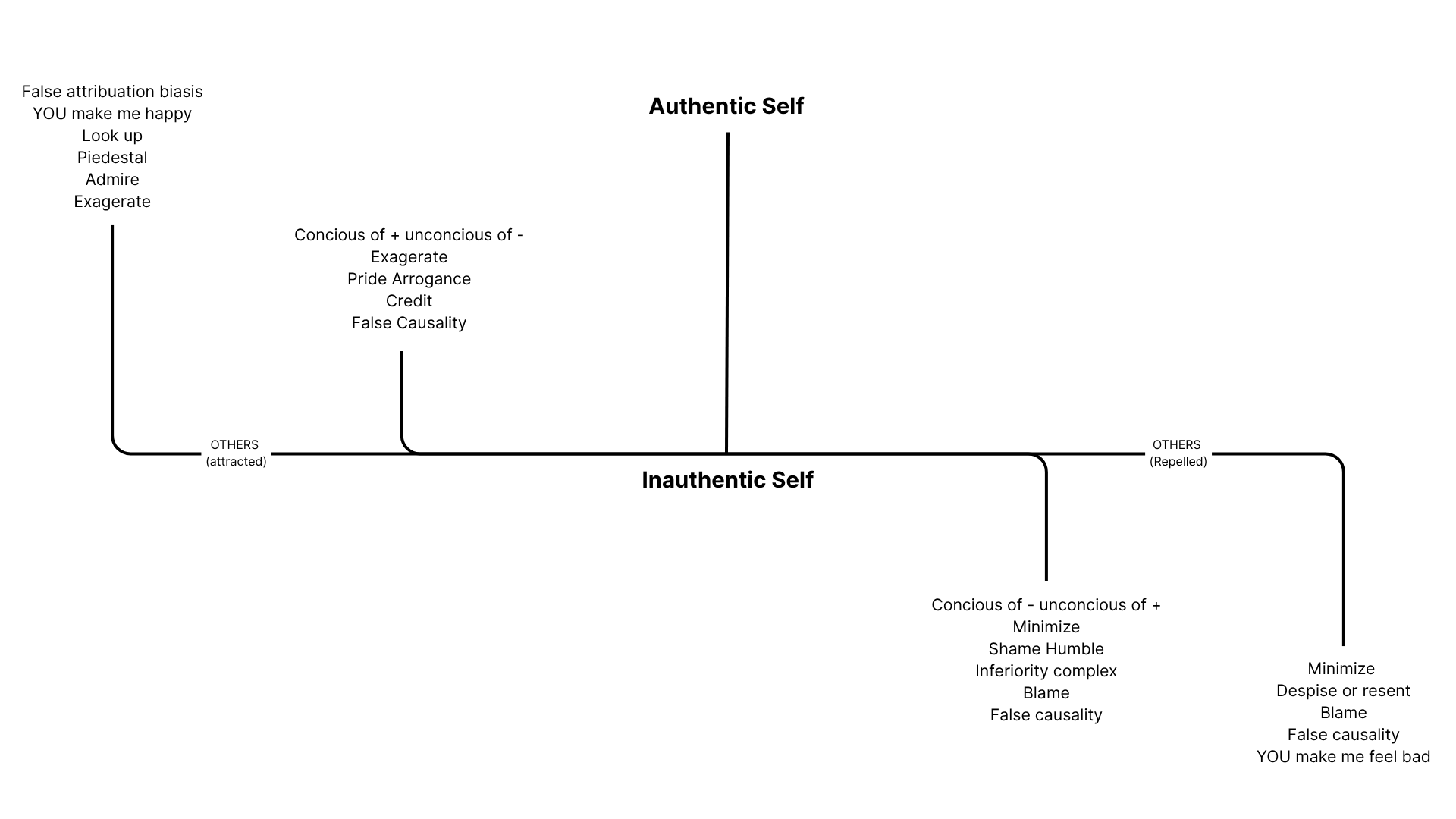
The Pleasure Principle (Positive Bias) - When we're attracted to someone or something, we see mainly the positives and become unconscious of the negatives. This creates false attribution: "YOU make me happy."
The Pain Principle (Negative Bias) - When we're repelled by someone or something, we see mainly the negatives and become unconscious of the positives. The false attribution flips: "YOU make me feel bad."
The Authentic Self is the way out of this trap—the state of centered awareness. In this state, perception is no longer polarized. You don't exaggerate positives or negatives, you don't pedestalize or blame, and you stop giving false credit or false causality to others.
The Purpose of the Egotic Structure
And so this egotic structure's purpose is to protect us from being touched and hurt in our vulnerability. It gets activated to protect the very thing we actually want to reach!
We want to reach our inner child, our pure creativity, but when we dance, we can't. Because dancing is the most vulnerable activity you can do. It's just showing yourself. You can't hide behind a mask, a status, a good joke, a way of being. No, it's just you, and you need to show up and open up.
The protector parts see this vulnerability as danger. All their alarms go off. "Alert! Alert! Exposure imminent! Deploy all defensive strategies!"
And this is why this approach is called Go Through. Because we want to go through our initial limitations, through the screams of the voices inside our head, to own our creative potential in the instant.
My Personal Practice - Dancing with the Voices
Let me share with you my personal way of using dance to go through emotional blocks.
Practice 1: The Voice Dialogue Dance
When I have a problem that I can't solve by thinking about it, when I feel like I need to release something, here's what I do:
I go to my dance studio (or any space where I can move freely). I put on music—something that supports introspection but also movement.
First, I rest in the witnessing awareness, the bigger consciousness. I try to access a non-contracted state, a place of openness and curiosity. This might take a few minutes of just breathing, feeling my body, letting the mental chatter settle.
Then I invoke the first self that wants to talk, usually the main voice that's been loudest about this problem. I literally ask internally: "Who wants to speak about this issue?"
Let's say it's about a problem with a friend—I'll use the example of my fake friend Hugo. A voice comes forward, maybe the Angry One.
I ask it: "So what do you have to say to Eliott about this problem with Hugo?"
The voice starts talking internally: "He never asks me before he makes decisions that affect both of us! He just does whatever he wants and expects me to be okay with it!"
But here's the key—as the voice talks, I physicalize it in my body. I don't just think the anger, I embody it. I amplify it. I let it move through me, getting bigger and bigger. Maybe my movements become sharp, aggressive, pushing. Maybe I'm stamping, punching the air, taking up space aggressively.
I keep asking questions from the witnessing awareness: "What else? Tell me more. Show me in the body what this feels like."
I amplify and amplify until the emotion is fully expressed, until there's no more accumulated, crystallized emotion to release. Sometimes this takes five minutes, sometimes twenty. I know it's complete when the energy naturally starts to settle, when the voice has said and expressed everything it needs to.
Then, still from the witnessing place, I ask: "What advice do you want to give Eliott about this situation?"
The voice might say: "He needs to set boundaries! He needs to speak up!"
Then comes the crucial question: "And who is forbidding you from giving this advice to Eliott? Who stops you from setting boundaries?"
This is where it gets interesting, because there's always another voice in opposition. Always. The psyche works in polarities.
The Angry One might say: "The People Pleaser won't let me! It's terrified of confrontation!"
So then I thank the Angry One—genuine gratitude for its expression and its care for me. I let it know I've heard it.
Then I go back to the witnessing awareness. I take a moment to center, to return to that open, curious state. And then I invoke the opposite voice, the People Pleaser.
"People Pleaser, I'd like to hear from you about this situation with Hugo."
And now a completely different energy enters my body. Where the Angry One was sharp and aggressive, the People Pleaser might be soft, collapsed, anxious. My movements become smaller, more tentative.
"I don't want to say anything to Hugo! He'll think I'm weak and needy! I don't want to lose his friendship! What if he gets angry with me? What if he leaves?"
Again, I physicalize all of this. I dance the fear of abandonment. I embody the terror of confrontation. I let it move through me fully until it too has expressed everything it needs to.
I continue this process with any other voices that want to speak.
The Integration
After all the voices have spoken and moved, I return to the witnessing awareness. I stand in the center of my space.
I imagine holding all these voices, all these parts of me, in my hands. The Angry One in one hand, the People Pleaser in the other, maybe other voices arranged around them.
Then—and this is profound when you really do it—I bring my hands together, collapsing the polarities. I bring all these voices together and then place my hands on my heart, integrating them all.
I feel genuine gratitude for all the voices inside me. They're all trying to help in their own way. They all care about my wellbeing, even if their strategies conflict.
From this integrated place, I can finally act. I can do something about the situation—whether that's speaking up, letting it go, or finding a creative third option—but now it comes from a non-reactive place. It comes from choice rather than from the domination of one voice over the others.
Practice 2: Dancing Through the Blocks
The other process I use is for when a voice comes up while I'm actually dancing and blocks me in some way. This is more spontaneous, less structured.
Let's say I'm in a dance session and suddenly I notice I'm holding back. I feel self-conscious, awkward. The Critic is active: "You look stupid. Everyone can see you don't know what you're doing."
Instead of trying to push through this or ignore it, I dance it. I physicalize it completely.
If I feel like I'm dancing like crap, I deliberately dance like crap! I mean really terribly—I exaggerate it, make it even worse. I embody "crappy dancing" fully.
And you know what happens? It's amazing—suddenly all this creativity emerges from this place. When I fully embody "dancing badly," it transforms into something else.
The key is to GO THROUGH the voice, not around it. To give it full expression through the body rather than trying to suppress it or transcend it.
But Why Do These Voices Get Activated?
Now we come to the real question: why do these voices get activated in the first place? Why do they have such power over us?
When these voices appear in the right amount, they're actually healthy. A little bit of caution (Controller) keeps us safe. Some drive (Pusher) helps us achieve things. Some self-criticism (Critic) helps us improve.
But for most of us, these voices aren't balanced. They're not gentle suggestions—they're screaming alarms. They don't guide—they paralyze.
Why? Because of trauma. Because somewhere in our past—often very early in our lives—something happened that created a body memory of danger. And whenever there is an unadapted emotional reaction to a situation (too strong or no emotion at all), it means there is a trauma behind.
The Chain Reaction
The sequence that I feel is true for me:
- Body Memory: First, there's a sensory memory stored in the body from a past experience
- Emotion: This body memory triggers an emotion (fear, anger, sadness)
- Selves Invoked: The emotion activates certain voices/selves to avoid getting hurt again
- Thoughts: Finally, these voices generate thoughts and mental stories
Most therapy works at level 4 (thoughts) or maybe level 3 (the voices). But in the approach I'm going to tell you about, we work straight to level 1—the body memory itself. Because if you can resolve the original body memory, everything else in the chain dissolves.
The Science of Trauma
Van der Kolk: The Body Keeps the Score
Bessel van der Kolk spent decades researching trauma, and what he discovered is that trauma isn't primarily a story in your mind. It's an imprint in your body and nervous system.
Your brain has three distinct levels that process experience in very different ways.
The Reptilian Brain (Brain Stem) - This is your most ancient survival system. It runs your automatic functions—heartbeat, breathing, basic reflexes. It also stores the "freeze, fight, flight" responses. The crucial thing about this brain level is that it reacts BEFORE any conscious thought.
The Limbic System (Emotional Brain) - This is where your emotions live. The amygdala acts like an alarm system, constantly scanning for threats. When something overwhelming happens, your amygdala goes into overdrive while your hippocampus shuts down. You get intense sensations and emotions without any coherent narrative context.
The Neocortex (Thinking Brain) - This is your rational, thinking mind. But when trauma gets triggered, the connection between this thinking brain and the emotional/survival brains gets severed.
This is why talk therapy alone often fails with trauma. You can't think your way out of something that lives below thought.
Stephen Porges: The Three States of Your Nervous System
Stephen Porges developed what he calls the Polyvagal Theory:
Ventral Vagal (Social Engagement State) - This is when you feel safe and connected. Your face is expressive, your voice has range, you can be creative and playful. This is the state where authentic improvisation happens.
Sympathetic (Mobilization State) - This is fight or flight. Your heart races, your breathing gets shallow, you're hypervigilant.
Dorsal Vagal (Immobilization State) - This is freeze, shutdown, dissociation. Your energy plummets. You might feel numb, exhausted, depressed.
Neuroception: Your nervous system is scanning your environment for safety or danger about 200 times per second—and this scanning happens below conscious awareness. The problem with trauma is that it miscalibrates your neuroception system. Your body starts detecting danger where there isn't any.
Understanding TIPI - The Sensory Memory of Fear
Luc Nicon developed something called TIPI—Technique for the Sensory Identification of Unconscious Fears.
He found that every emotional difficulty—every phobia, every anxiety, every depression, every paralysis—has its origin in a specific sensory memory stored in the body. Not an intellectual memory, but a body memory. A felt experience that got frozen in time.
When you truly allow yourself to feel the body sensation without the mental story, without trying to fix it or understand it, the sensation begins to shift. It might get stronger at first. You might feel other sensations emerging. You keep following the sensations, like following a thread.
And when you can stay with those original sensations—fully feel them in your body without the protective defenses kicking in—something remarkable happens: the experience completes itself. The frozen energy moves through. The record unsticks.
The Disproportionate Response
As a reminder: when there's a disproportionate emotional response to a current situation, there's always an earlier trauma being triggered. The body is responding not to what's happening now, but to what happened then.
If someone gives you minor feedback and you're devastated or angry, that's disproportionate. If you need to perform and you're so terrified you physically can't do it, that's disproportionate.
These disproportionate responses are your clue that you're not actually responding to the present situation.
Going Through in Practice
So how do we work with this understanding in dance and movement?
First, we need to recognize what's happening. When you feel blocked in your dance, when those voices get loud, pause. Don't judge. Just notice: "Ah, something in me is protecting right now. There might be an old body memory being triggered."
Then, instead of trying to think your way through it, feel your way through it. Where is the sensation in your body? Is it a tightness in your chest? A knot in your stomach? Shaking in your legs?
This is the key insight: when you fully feel a sensation—when you give it your complete attention without trying to fix or change it—it naturally begins to transform. It's like the frozen experience finally gets to complete itself.
Dancing as Completion
This is why dance is such a powerful medium for this work. Because dance allows us to complete what couldn't be completed before.
That fetus who couldn't run from danger? In dance, you can run. You can move through space, you can escape, you can complete that flight response.
That baby who couldn't fight back? In dance, you can push, you can be strong, you can express your power.
That child who was shamed for being too big, too much? In dance, you can take up all the space you want. You can be enormous. You can be "too much" and discover it's actually just right.
Every time you dance through a block—every time you fully embody and express what was suppressed—you're completing an old, incomplete experience. You're updating your system. You're showing your protective parts: "Look, I can handle this now. I'm not a helpless baby anymore. I have resources. I can move, I can express, I can choose."
The Integration Process
But here's something crucial: we're not trying to get rid of these voices. We're not trying to eliminate the protective parts. That would be like firing your security team—not a good idea.
Instead, we're helping them update their job descriptions. We're showing them that the you of today has resources that the you of back then didn't have. We're negotiating new arrangements.
The Perfectionist doesn't need to disappear—it can become the part of you that helps refine your art when appropriate. The Controller doesn't need to be destroyed—it can help you maintain healthy boundaries. The Critic can transform into discernment. The Pusher can become healthy motivation.
This is integration—not elimination, but transformation. Not suppression, but evolution.
Why This is Useful to You
Here's the thing I've discovered through years of practice: being able to recognize and identify what's happening inside of you allows you to detach yourself from it. When you're glued to your emotions and the voices of your egotic structure, you're trapped in a small reactive self—you're being taken by your emotions, not being able to see clearly. It's like being caught in a storm and thinking you ARE the storm.
But when you can name the processes that are happening—"Ah, that's my Perfectionist getting activated by this performance situation," or "I notice my Controller is trying to protect me from feeling vulnerable"—suddenly you have space. You come back to awareness instead of fixating your attention on the drama. You can treat the problem from the right level.
Next time you have a problem—whether it's creative block, relationship tension, or just feeling stuck—I highly recommend you try the voice dialogue dance process I mentioned. Set aside 30-45 minutes when you won't be interrupted. Go to a space where you can move freely. Put on music that supports introspection but also allows for expression.
Here's why this one practice is so powerful: in one exercise, everything happens. You understand the wisdom of each voice, which gives you more clarity on the choice you need to make. You release the emotion that's been stuck in your system. Sometimes you even decrystallize the body memory that got triggered in the first place. You always finish by collapsing the polarities between opposing voices and integrating them with gratitude.
A Word of Caution
Before you rush off to explore your traumas on your own, I need to be honest with you: this work can be intense. Really intense.
When you start following body sensations back to their origins, you're opening doors that your system closed for a very good reason—because at the time, what was happening was too much to handle. And sometimes, when you open those doors alone, the intensity can overwhelm your capacity to stay present with it.
What can happen is this: you access the trauma, the sensations start flooding back, but instead of completing and releasing, you get retraumatized. You're back in that overwhelming state, but now you're stuck there without the resources to move through it.
This is why, even though I'm telling you these concepts, I strongly recommend working with a trained TIPI practitioner, psychologist, or trauma-informed coach when you're ready to explore these deeper layers. They know how to help you build the capacity to stay present with intense sensations. They know how to help you "pendulate"—dipping into the sensation and then coming back out to safety—so you don't get overwhelmed.